Compton V3 Camera | Damavan Imaging
Radiation like you've never seen it before
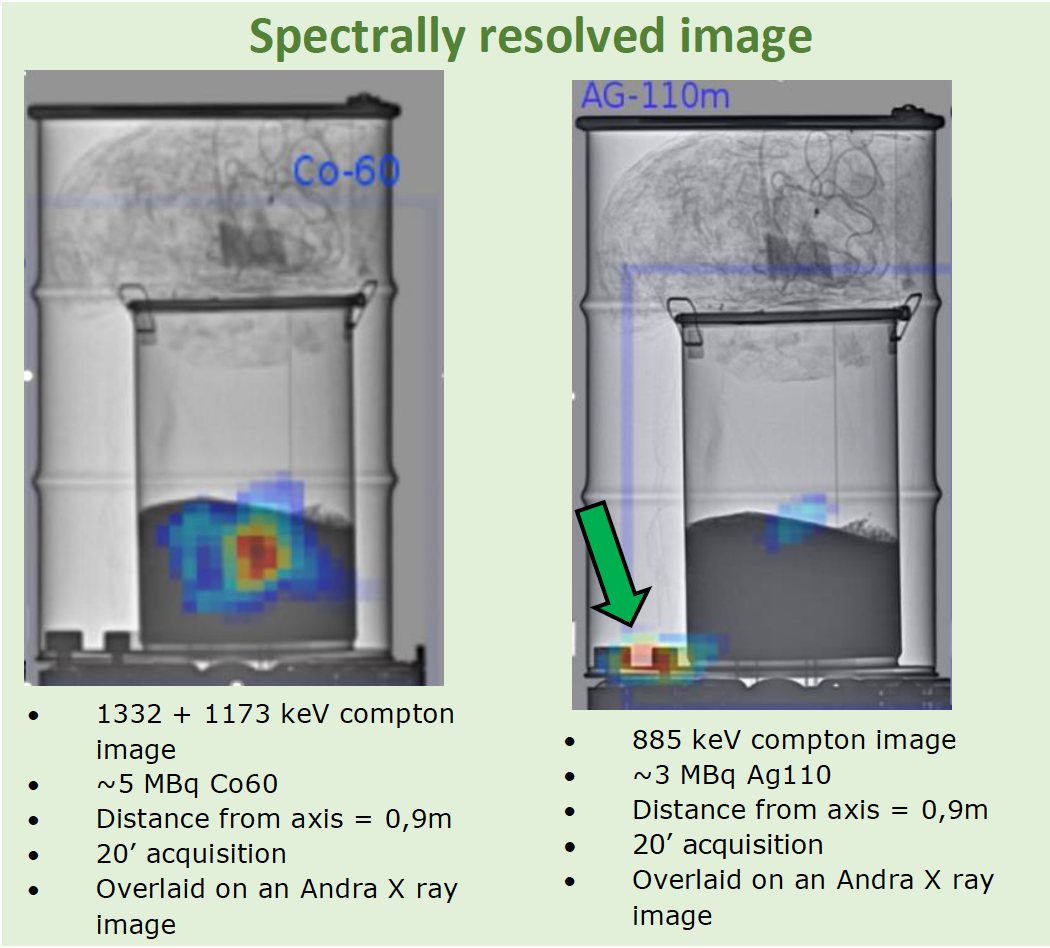
DAMAVAN's Compton V3 Camera combines the detection of gamma radiation with the real image of the environment, in order to locate radioactive sources in real time. In addition, it has a spectrometry function that allows the identification of detected radioisotopes, such as radioactive iodine (I131).
Compton V3 Camera:
New technology for imaging ionizing radiation
1
Best sensitivity and image quality on the market
2
Identification of isotopes
3
Real-time display
4
Spectrometry function
5
Mapping with hotspot detection and 3d image
6
Its applications in dismantling and waste management stand out
Features Compton Temporary Imaging Camera V3
Obtaining 3D images of gamma radiation
- Detection of sources in 4 π with low activity (from 900 Bq)
- Energy range from 400 keV to 3 MeV for image
- Simple dosimetry
It has an exceptional signal / noise ratio, which gives it great image quality
The most sensitive Compton Chamber on the market
- 30-50% shorter acquisition time than other cameras
- Sensitivity <1 nSv/h allowing natural background imaging
Equipped with a small CZT spectroscopic detector
- Energy range from 50 keV to 3 MeV for spectroscopy
- Identification of isotopes
Stable photon counter with dose estimation
Interface through the 12' laptop included in the pack
Built-in rangefinder
Compact and transportable
4 hours of battery life with the 1.2 kg external battery kit
Delta V3 Applications
- Nuclear facilities in operation
- Characterization of sources
- Mapping of zones for routine operations
- Obtaining images from very low intensity sources
- National security applications
- Estimation of the mass of the source
Fields of application
- Nuclear facilities in operation
- Radioactive Waste Management
- Dismantling of Nuclear Power Plants
- Inspection of substances with radiological activity


How does the Compton Camera v3 work?
Its operation is based on the use of scintillation detectors and semiconductors for the detection of gamma radiation. This device uses the light and the temporal distribution of each scintillation event to precisely locate each decay of the source, obtaining the spatial distribution and energy of these.
Technical Specifications Compton Camera v3
| Field of view | 96 x 96 Flat field Flat field | Resolución temporal | 300 ps @ 511 keV | Operating temperature | -20˚ C a 40˚ C | Spectral resolution | <1.5% @ 662 keV |
| High flow sensitivity | 3 mR/h < 1 mm | Angular resolution | <10˚ (entire spectre) <8˚ (energy gated) | Energy range | 50 keV- 3 MeV (spectroscopy) 500 keV -3 MeV (image) | Weight | 3,9 kg |
| Count limit | > 0,5 mSv/h | ||||||
| Low flow sensitivity | 900 Bq Co-60 en 1 m2 @ 1 m en 1.5 h | Sensors | CeBr3 + CZT | Connection | Ethernet Wifi | Power supply | 110 – 220 V |